Dean, I used AI to help dig through this for you. I gave it your posts and the Cater passage, and had it work through old books, newspaper references, folklore collections, and the surviving illustrations. What follows is the research brought together in one place, with the sources beside the relevant passages so you can follow whichever part catches your interest.
The cave detail was what particularly caught my attention, but I also wanted to follow your other question... whether we have been assuming the wrong starting point when we call something a person turning into a wolf. That is a rather different question from simply collecting more werewolf stories.
The exact newspaper drawing hasn't been identified yet. There are, however, some specific older accounts of caves, female werewolves, and more than one explanation of what the apparent change of form represents. I think those are worth putting in front of you together.
The cave connection has some very specific counterparts
A Scottish cave occupied by successive generations
The closest British passage in the research is in Elliott O'Donnell's Werwolves (1912), chapter VI, printed pages 108-109.
O'Donnell records a story about Saunderson, near Ben MacDhui, who was suspected locally of being a werewolf. He lived in a mountain cave previously occupied by his forefathers, who had attracted the same suspicion. After his death, villagers were said to have entered the cave and found both human and wolf bones.
O'Donnell supplies a chain of tellers rather than presenting this as something he witnessed himself:
flowchart TD
    A["Tam McPherson remembers Saunderson"] --> B["Colin Graeme's grandfather"]
    B --> C["Colin Graeme, a shepherd"]
    C --> D["O'Donnell records the account in 1912"]
That is the transmission of the account, not a family tree. O'Donnell also mentions comparable Welsh traditions.
The detail that makes this relevant is the same cave associated with more than one generation, rather than a wolf merely taking temporary shelter. The missing connection is an earlier newspaper version or illustration. The book's 1912 publication doesn't supply that connection by itself.
Read Werwolves; search within the book for Saunderson.
An old court record actually says "under the earth"
There is a different underground association in the proceedings involving Old Thiess of Livonia. The hearing begins on April 28, 1691; the transcript was filed with the 1692 case papers, which accounts for the two dates commonly attached to it.
On printed page 18, page 8 of the PDF, Thiess says:
"It's not on top but under the earth"
He describes a guarded entrance that outsiders cannot use. In the same part of the questioning, he says:
"Women were certainly among the werewolves"
His account presents the werewolves as going below to recover agricultural prosperity taken by sorcerers. He calls them "God's hounds," opposing rather than serving the devil.
Here we have historical testimony connecting werewolves, women, and an underground destination. Thiess describes journeys into that realm, not a population that permanently lives there. That gives us another sort of underground association to compare with the Scottish cave-dwelling account.
Read the published trial transcript at the relevant page.
A female werewolf and a concealed skin in a cave
Sabine Baring-Gould's The Book of Were-Wolves (1865), chapter VIII, records an Armenian narrative that brings the female and cave questions together.
A pursuer follows a wolf's trail to a cave and discovers a wolf-skin. When he tries to burn it, a woman appears and attempts to recover it. In this account, the skin is central to the change of form.
Baring-Gould names his source: Haxthausen's Trans-Caucasia, volume I, page 322. That gives us a route back through the literature rather than leaving us with an unattributed internet retelling.
So the combination woman + wolf identity + cave + something connected with changing form was already in a nineteenth-century collection. It belongs to a different tradition from O'Donnell's Scottish account, but it directly addresses two of your questions.
Read Baring-Gould's book; search for Haxthausen.
Dog-headed cave-dwellers, without the usual transformation story
Another comparison comes from Ctesias's Indica, preserved in Photius's Bibliotheca, section 72. The account describes the Cynocephali, or dog-headed people, as a population with men and women, subsistence activities, and exchanges with neighboring people. It says:
"They do not live in houses, but in caves."
The interesting part for your question is the way the account is framed: these are beings with a characteristic bodily form, not people temporarily suffering a wolf curse.
It doesn't describe them assuming human disguises, and dog-headed people should not simply be renamed werewolves. Still, Cynocephali gives us an additional historical search term for the particular idea of nonhuman-looking cave inhabitants.
Read Photius's summary; search for Cynocephali under "History of India."
And yes... female werewolves long predate the pink ribbon 
The Ossory account recorded by Gerald of Wales in the twelfth century has a male and female pair. A male wolf approaches a priest and asks him to attend his dying female companion. He explains their condition and reveals the woman's human appearance beneath the wolf covering.
That is an explicit female example in medieval writing, quite apart from the women in Thiess's testimony and the Armenian skin-and-cave narrative.
Kilkenny Castle's discussion of the Ossory sources.
There is also a particularly close nineteenth-century literary parallel in George MacDonald's "The Gray Wolf." An English traveler on a Shetland island encounters a little cliff cave with animal bones outside it. A young woman enters the story, and later the encounter moves between woman and wolf. At one point the apparent wolf becomes a woman in his grasp, before the wolf appears again.
That brings together the cave, bones, a female wolf-being, and the wolf-to-woman sequence you were asking about. It is fiction, so its use here is as a possible source of imagery and as a record of the idea, rather than a newspaper report of an encounter.
Read "The Gray Wolf" in The Portent and Other Stories.
For the publication trail, there is an identifiable 1871 edition of Works of Fancy and Imagination, volume 10, containing the story. That is a sound edition to pursue for nineteenth-century appearances and reprints. There is a short dating note in the additional source notes below.
University of Toronto copy of the 1871 volume, digitized at Internet Archive.
Your question about which form comes first
This is the part I would keep open rather than automatically squeezing everything into the familiar human-under-a-curse explanation.
There are actually several different questions here. What form does an observer see first? What form is usual for the being being observed? And what, in the account's own explanation, is doing the changing? Those need not have the same answer.
A reported wolf-to-human transition gives a direction for that particular event. It doesn't, on its own, tell us which form is native or original. Your suggestion asks that further question.
The research also turned up animal-to-human identity stories outside the European werewolf tradition. Sarah A. Peterson-Camacho discusses Chumash narratives preserved in Thomas Blackburn's December's Child: "The Coyote Imitates People" and "The Dog Girl." In these, the human appearance is assumed by a coyote or dog, rather than an ordinary human first becoming an animal. This lead comes through Peterson-Camacho's discussion of the collection, not a fresh examination of the original collected narratives.
Peterson-Camacho's article, including the Chumash material and bibliography.
That isn't the same tradition as the Scottish cave story. But it does show why searching only under the standard European werewolf formula could miss accounts closer to what you are proposing.
The wulver is a very close comparison, with a later printed source
The Shetland wulver is described as a wolf-headed, human-shaped being living in a cave, rather than a person who periodically transforms. As a description, it comes very close to your question about a being whose nonhuman form is its normal one.
The publication history matters here. Brian Smith at Shetland Museum and Archives traces the familiar wolf-man description to Jessie Saxby's 1933 Shetland Traditional Lore. His investigation argues that Saxby's treatment of older place-name material produced this description; the earlier records he discusses concern fairy-associated names rather than the same recorded wolf-man account.
So the wulver belongs in the comparison, but its familiar description should not be used to date your newspaper illustration to the 1800s. It is also a useful name to recognize while looking through modern pages about wolf-headed cave-dwellers.
Read the Shetland archive's investigation of the wulver.
Cater is already asking a related question, but in terms of the intelligence
Looking at the Cater passage you posted, his proposed starting point isn't simply an ordinary human body with an inexplicable tendency to grow into a wolf.
He proposes an intelligence accustomed to an earlier, different bodily form, now incarnated as a human, that can under certain conditions re-express that prior form. His soul-center and step-down-energy explanation concerns how that intelligence might produce the change.
That is related to your reversal. In both cases, the present human appearance need not tell the whole story. But your suggestion concerns a nonhuman being taking a human appearance, while Cater is also invoking a history of different incarnations. Those are related possibilities, not interchangeable ones.
There is a detail in his passage worth bringing forward: Cater does claim that an acquaintance saw a transition back to human form, after the creature leapt onto a garage roof. He also says another observer corroborated that encounter. The account doesn't give their names or the identifying details needed to follow their testimony independently, but this is the passage most directly relevant to your question about somebody actually describing the change.
Heindel describes a manifestation, not simply an altered physical body
Question 128 of Max Heindel's Rosicrucian Philosophy in Questions and Answers offers another explanation. He describes the werewolf as a magician's vital body, shaped into a frightening form and partly furnished with dense matter. Injuries to that manifestation are said to correspond to injuries on the person's physical body.
Here the model is a second or manifested body, not merely the anatomical conversion of the body standing in front of us. That makes an interesting comparison with Cater's etheric/materialization ideas, although the research hasn't established that Cater derived his account from Heindel.
Read Heindel's answer to question 128.
The Kilkenny Castle discussion also mentions a thirteenth-century poem in which people leave their human bodies behind while taking wolf form, with injuries reflected on the human body. That particular lead comes through the castle's historical discussion. It suggests that a separate-body explanation is worth following beyond the later Rosicrucian literature.
A change of appearance and a change of occupant are different questions
The other material you brought in, concerning one intelligence occupying or interfering with another's body, adds a further possibility within that esoteric framework. It asks who is occupying the body, rather than only what the body looks like.
So I would distinguish the explanations this way:
| Explanation being proposed | What changes? |
|---|---|
| Human-to-wolf transformation | The person's ordinary bodily form. |
| Nonhuman being assuming human appearance | The visible presentation of a being whose original form is something else. |
| Cater's earlier-incarnation explanation | The form expressed by an intelligence with a different bodily history. |
| Heindel's vital-body explanation | A secondary manifestation, while the physical person remains distinct. |
| Occupation or possession | The intelligence acting through an existing body. |
These are explanations found in, or prompted by, the material under discussion, not five demonstrated mechanisms. Keeping them separate lets us ask much better questions of an account: does it describe a continuous physical change, a separate body elsewhere, a change of identity, or only two appearances seen at different times?
Your later thought about beings living among people extends the second question into sustained human identity, rather than a momentary appearance. The historical material helps frame that question, but it doesn't identify present-day individuals or establish an agenda for them. For this search, the useful connection is the older idea of human appearance not necessarily disclosing the identity behind it.
Back to the missing newspaper drawing
Your description gives us several things to look for together: a drawing, a British newspaper attribution, an 1800s date, a named town, a local scare, and caves in the area. None of the recovered candidates has yet been connected to all of those details.
The concrete newspaper reference carried forward from the earlier research is:
"Werewolves" - Bristol Mercury, February 12, 1894.
The earlier research located that title-and-date label on the British Newspaper Archive's "Halloween in History" page. The original issue has not been inspected, so the page number, presence of a creature drawing, named locality, and cave wording remain unchecked. The public blog also blocked access during the latest link check. This is a specific issue to inspect, not an identification of your picture.
British Newspaper Archive: "Halloween in History."
Date-restricted BNA search for Bristol Mercury, February 12, 1894, and "werewolves."
There are two routes worth leaving open. We may find the drawing and cave account together in the original newspaper. Or we may first recover the webpage on which you saw the drawing, where the newspaper credit and cave information could appear in surrounding text. Finding either would help recover the other; there is no need to decide the arrangement in advance.
flowchart TD
    A["The page Dean remembers"] --> B["The drawing"]
    A --> C["Caption and newspaper credit"]
    B --> D["Earliest identifiable reproduction"]
    C --> E["Named town and cave wording"]
    D --> F["Recover the original page and context"]
    E --> F
Also, a British newspaper could have reported something outside Britain. The newspaper's country needn't be the location of the town in the story. That is worth keeping in mind before restricting the search to British place names.
Actual Victorian illustrations to compare
Clemence Housman's The Were-Wolf gives us a useful group of surviving pictures because its female werewolf, White Fell, was illustrated twice in the nineteenth century.
The story appeared in Atalanta, December 1890, with illustrations by Everard Hopkins. The 1896 book used a different set, designed by Laurence Housman and engraved by Clemence Housman. These are literary illustrations, not pictures already linked to a cave scare. Their immediate value is recognition: one may look familiar, or let us put a whole group of possibilities aside.
The COVE scholarly edition compares the magazine and book illustrations.
"The Race," 1896
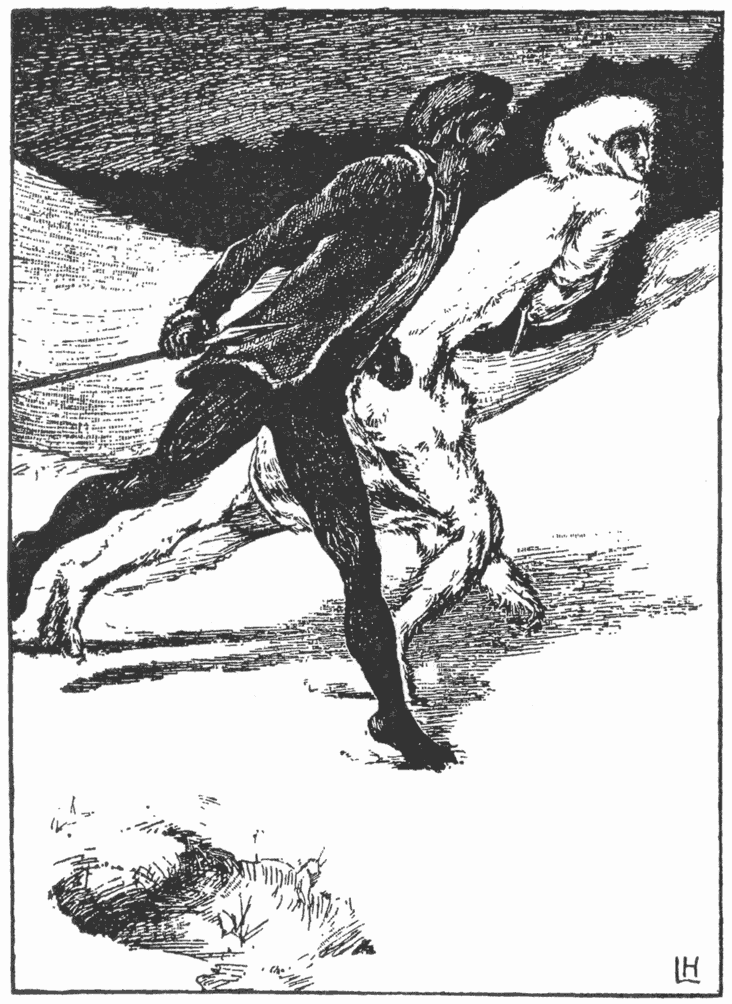
Laurence Housman, design; Clemence Housman, engraving. Plate 4, facing page 80. Reproduction linked from Project Gutenberg.
Open the university collection's record for "The Race."
"White Fell's Escape," 1896
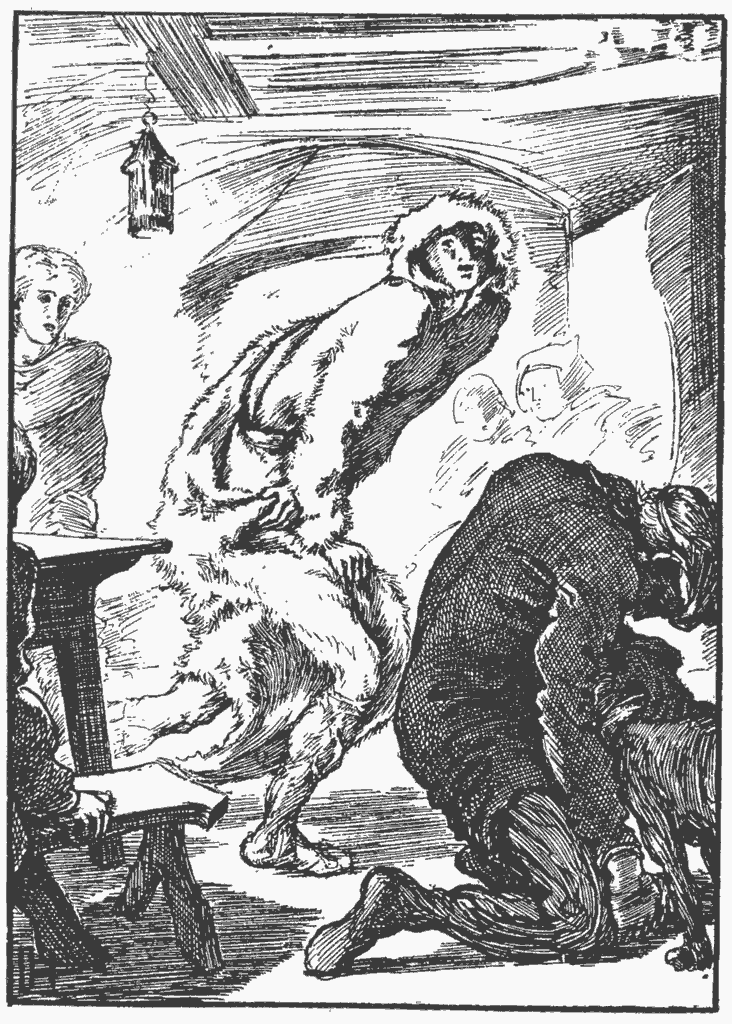
Laurence Housman, design; Clemence Housman, engraving. Plate 3, facing page 60. Reproduction linked from Project Gutenberg.
Open the university collection's record for "White Fell's Escape."
The earlier 1890 Atalanta pictures look different. Two directly catalogued examples are the full-page illustration on page 136, captioned "I fear neither man nor beast; some few fear me!", and the inset on page 155, showing a wolf pack with a dead white wolf.
View the 1890 full-page illustration, page 136.
View the 1890 wolf-pack illustration, page 155.
The complete illustrated 1896 book is also available here.
The things that would help distinguish your drawing are quite physical: two legs or four, human hands or paws, clothing, a weapon, one creature or several, and whether a cave entrance was actually drawn. A recognizable detail in a picture may be more useful than another page containing the word "werewolf."
The Los Angeles material needs two dates kept in view
The newspaper trail found alongside Cater is specific enough to pursue. Peterson-Camacho's article supplies these references:
| Newspaper reference | Page |
|---|---|
| "Rumors of Ogre Pour into Police," Long Beach Press-Telegram, May 4, 1961 | 14 |
| Matt Weinstock, "Light Thrown on Werewolf," Los Angeles Mirror, May 11, 1961 | 3 |
Her account describes reports to police and a scare spreading through schools, including descriptions of a dog-bodied creature with a woman's face. The original newspaper pages have not been inspected in this research.
Read Peterson-Camacho's discussion and newspaper bibliography.
Cater dates his episode to 1962 and gives a distinctive additional story: a teenager tries to pull off what he thinks is a mask, discovers it will not come away, suffers torn clothing and injuries, and is hospitalized in shock.
That mask-and-hospital account has not been matched to the recovered newspaper references. The 1961 references therefore do not establish that Cater got 1962 wrong. They could concern an earlier scare, the background to his account, or a separate episode. His particular incident still needs its own contemporary source.
The unnamed scientist's book is a separate missing document
Cater's reference to a "Hindu scientist" remains one of the most interesting unfinished parts of this. In the passage you posted, he gives no author, title, publication language, or identifiable archive collection. He says an unnamed Rosicrucian acquaintance had access to a book containing research and photographs.
The source chain in the passage is therefore:
Scientist and book -> acquaintance who reportedly read it -> Cater's account.
Cater doesn't say there that he personally examined the book or photographs. The six-times-human-strength and two-per-million figures are distinctive phrases to search, but the passage doesn't supply the measurements or methods behind them.
An author or title has not emerged from the research so far. That leaves an unresolved bibliographical reference, not a basis for declaring that the book never existed. A manuscript, private translation, pamphlet, or restricted-circulation work could require a different search from a commercially published book.
Also, "Rosicrucian" doesn't identify a particular institution or collection. Finding Heindel's explanation doesn't establish that his organization held Cater's source, and an archive inquiry should leave that question open.
The useful request is for a document or catalogue trace, rather than for somebody to endorse the account. I have put a ready-to-use version in the notes below, along with the newspaper request, so those details don't get lost.
Additional source notes and archive requests
Publication details and secondary leads
MacDonald's date
The earlier research repeatedly called "The Gray Wolf" an 1864 story, but did not establish a publication reference for that year. The additional catalogue check identifies it in volume 10 of Works of Fancy and Imagination, London: Strahan, 1871. That is the dated edition used here; it is not a claim that 1871 has been established as the first appearance.
The digitized University of Toronto volume and its contents record.
The important content remains the same: the Shetland setting, cave, bones, female figure, and apparent transition in both directions. Searches for periodical appearances should include "Gray Wolf" and "Grey Wolf," together with MacDonald's name, rather than assume a particular first-publication year.
Other illustration and newspaper leads from the earlier research
Baring-Gould's 1865 frontispiece is another illustration worth checking in a scanned edition of The Book of Were-Wolves. It is a visual lead, not an identified newspaper plate, and should not be silently attached to the Armenian cave narrative merely because both occur in discussions of the book.
Punch, December 23, 1893, "The Were-Wolf" is another dated British-periodical reference. The recovered item is an allegorical poem, not the cave-and-local-scare report being sought. It is a secondary search lead rather than a close content match.
Charles Fort's Lo!, chapter 13, supplies a later newspaper trail concerning unusual sheep killings in Gloucestershire in 1905. Fort cites the Gloucester Journal of November 4 for the invocation of werewolf traditions, and the Bristol Mercury of November 25 for an escaped-jackal explanation. This lies outside the remembered century and isn't the missing cave account. Its usefulness is the specific regional-scare newspaper trail, should the date search need widening.
The earlier research also found a discussion of lycanthropy in the 1942 Rosicrucian Forum volume. It treats the subject differently from Heindel's vital-body explanation. This is a comparison source, not an identification of Cater's archive or scientist, and reinforces the need to distinguish institutions rather than assume one uniform Rosicrucian explanation.
Search terms and a focused newspaper-archive request
Useful spelling variants are werewolf, werewolves, were-wolf, were-wolves, werwolf, werwolves, wolf-man, man-wolf, loup-garou, lycanthrope, and lycanthropy. For related cave-dweller descriptions, add wolf-headed, dog-headed, Cynocephali, and wulver.
Pair the relevant variants with cave, caves, cavern, caverns, den, lair, grotto, underground, under ground, subterranean, beneath the earth, or under the earth. Names worth trying independently include Saunderson / Sanderson, Ben MacDhui / Ben Macdui, Epynt, Shetland, Haxthausen, MacDonald, and White Fell.
The century in the recollection remains the starting point. The 1850-1875 and 1885-1900 bands contain several of the recovered book and illustration references. The 1905 and 1912 material can be kept as a separate later comparison rather than quietly moved into the Victorian evidence.
For drawings, useful newspaper and periodical targets include Illustrated London News, The Graphic, Illustrated Police News, Penny Illustrated Paper, Punch, and Atalanta. Captions, hyphenated words, and material outside the main columns may need visual inspection rather than a single exact-text search.
I am trying to identify a nineteenth-century illustration attributed to a British newspaper. The accompanying caption or article described a werewolf scare near a named town and said the creatures were associated with caves in that area. One reference recovered in the search is an item labeled "Werewolves," Bristol Mercury, February 12, 1894.
Could you identify that item's page number and confirm whether it contains an illustration, a named locality, or wording about caves, caverns, dens, or a local scare? A scan retaining the heading, surrounding text, and publication details would be especially useful. The reported locality need not have been in Britain.
Since the page was encountered recently, the browser or image-search history around the session before the September 22 post is another possible route. The pages immediately before and after it may help even when the missing page has an unhelpful title.
A focused inquiry about Cater's unidentified book
Joseph H. Cater's The Awesome Life Force, in the passage headed "Terrifying Metamorphoses and Displaced Intelligences," refers to an unidentified work by a "Hindu scientist" concerning werewolves, reportedly including photographs. Cater says an unnamed Rosicrucian acquaintance consulted the work in Rosicrucian archives.
Does your collection hold, or contain a catalogue entry or correspondence referring to, a work matching that description? Useful identifying details would include an author, title, original language, translation, accession number, earlier catalogue entry, or the identity of Cater's intermediary. A privately circulated manuscript, pamphlet, or translation would be relevant as well as a published book.
This is a request to identify the document and its history, not a request for the institution to endorse its contents.
For me, the material worth following most closely is the cave occupied across generations, the underground journeys in Thiess's testimony, and the distinction between a changed body, an assumed appearance, and a separate manifestation. Those are specific enough to compare without treating every account as though it says the same thing.
Dean, the one detail I'd most like to recover about your picture is this: was the cave visible in the drawing, or was it mentioned only in the accompanying words? That would help choose between pursuing a particular illustrated scene and tracing the local account behind its caption.