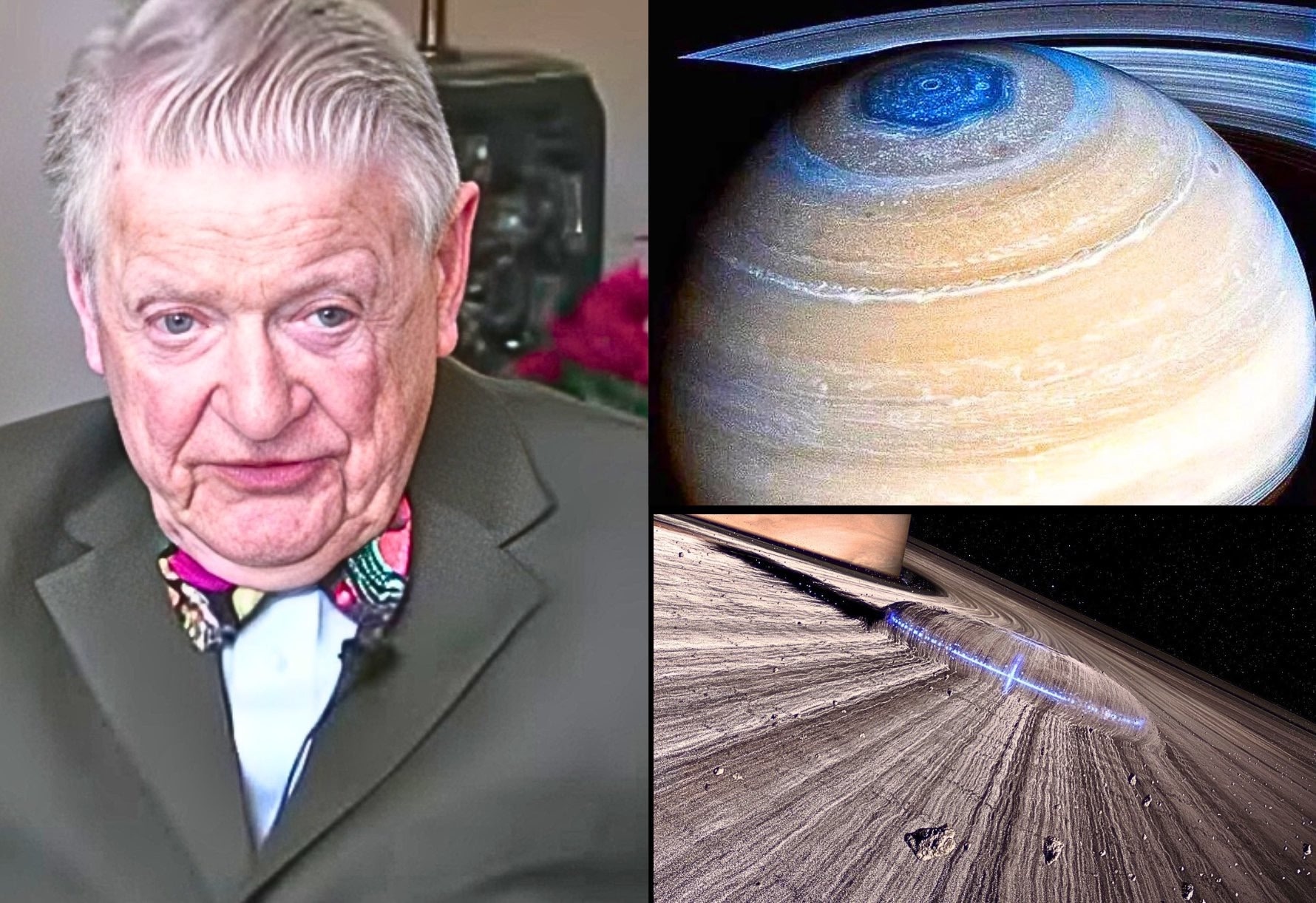
The author of "Ringmakers of Saturn":
Fascinating thread: https://x.com/Unexplained2020/status/1959730250482331955
I'll share some of the thread here:
The Strangest thing about Saturn is that This Man, who worked on the Voyager missions, said he discovered Enormous, Living, Electromagnetic Vehicles inhabiting its Rings.Dr. Norman Bergrun concluded, based on his analysis of Voyager 1 and 2 data, which he detailed in his 1985 book, Ringmakers of Saturn, that he discovered enormous, living, electromagnetic vehicles inhabiting the rings of Saturn.
Dr. Bergrun, who had worked for NASA, claimed that there were massive alien spacecraft proliferating in the rings of Saturn.
Dr. Bergun is the author of the books “Ringmakers of Saturn” and “Tomorrows Technology Today,” which document the existence of extraterrestrial vehicles of immense power. A scientist who pioneered the methodology of thermal ice prevention design, he is also credited with roll-stability laws for airplanes and missiles.
Dr. Bergrun was manager of test planning and analysis for the Polaris Underwater Launch Missile System and evaluated satellite system applications. Also a director of Information Systems, he founded his own company in 1971 and is cited in “Who’s Who in the World” and other reference works. He was an alumnus of Ames Research Laboratory, NACA (National Advisory Committee for Aeronautics), predecessor of Ames Research Center, NASA, where he worked for 12 years as a research scientist.
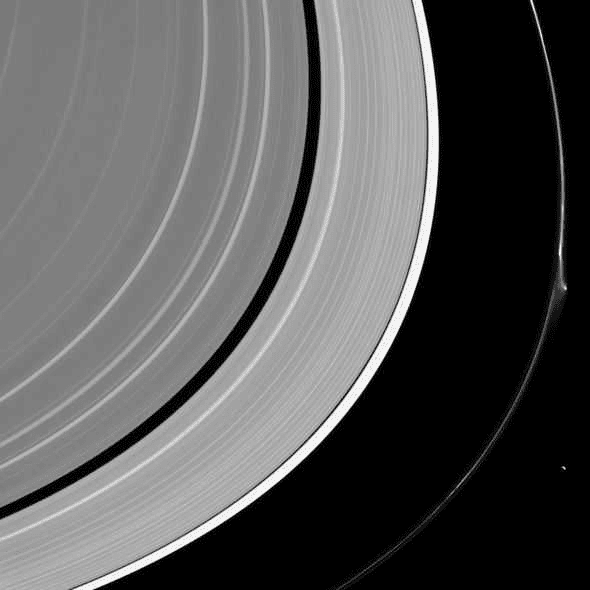
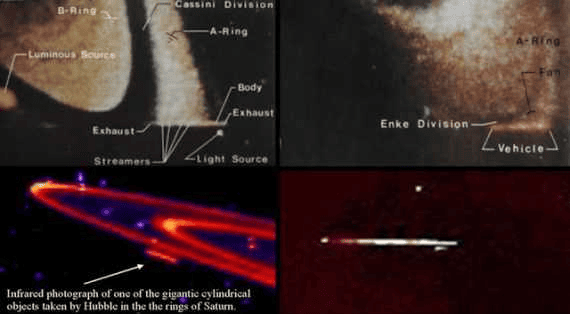
Dr. Norman Bergrun played a key role in the Voyager missions, the probes that were sent out to photograph Saturn, its rings, and its moons. There is a photo shown below from that mission, which he was able to obtain from the agency of a large unidentified flying object hovering just outside Saturn’s rings. It is huge, approximately the size of Earth, and is published in his book, “Ringmakers of Saturn.”Dr. Bergrun claimed that these rings were not made of ice and rock as is commonly believed, but were actually the exhaust from these massive craft, which he calls "ringmakers." He asserted that these vehicles are proliferating and are now also present at Jupiter and Uranus, creating new rings on planets that previously had none.
Dr. Bergrun recounted his professional history, mentioning his work at Lockheed on the first generation of the Polaris underwater launch vehicle.
This had led him to work in a top-secret area behind closed doors, where he had been required to sign a 30-year non-disclosure agreement.
He explained that he eventually left this role due to "claustrophobia," clarifying that it was not a fear of small spaces but rather the mental strain of being confined to the same secret room day after day.
It was during this period that he received his first clue about unusual things in space after being given a set of data that no one else could make sense of. When he plotted it, he realized that it showed something strange.
Web Archive: NASA Technical Reports Server (NTRS)He claimed that he faced significant opposition and cover-ups from official bodies such as NASA. He recounted a story about a source allegedly connected to NASA who asked him how he had found a particular image from the moon, remarking, "I thought we darkened that enough that you wouldn’t find it."
Dr. Bergrun also stated that his personal data and images, which he had stored in a supposedly impenetrable vault, were tampered with.
He claimed that unknown parties had “garbled” his files on laptops and disks, sometimes erasing them completely. Despite this interference, he believed he did not need the old data because he was so familiar with the subject that he could reconstruct his work at any time.
Dr. Bergrun said: “What I found out is, these things inhabit Saturn, that’s where I first discovered them, and they’re proliferating. You can find them around Uranus and Jupiter. Wherever you see some rings, that’s where I see the aircraft, I call them a ring maker. I say that it is electromagnetic because I can identify streamline patterns with respect to it that I knew were what we called ‘potential lines’ and that says it was electrical.”
In that book, Dr. Bergrun analyzed photographs of Saturn’s rings taken by the Voyager 1 and Voyager 2 spacecraft in 1980 and 1981. He detailed his theory that the rings were formed by giant Electro-Magnetic Vehicles (EVMs), which are possibly being controlled by intelligent beings.
He stated that the 7000-mile-long elliptical ships are currently orbiting Saturn within the rings and emitting visible exhaust. Later, analysis by Bergrun and others suggested the same or similar ships are in orbit around the Sun, Jupiter and Uranus.
Regarding the purpose of these vehicles, Dr. Bergrun disagreed with the theory that they were mining the rings.
Instead, he suggested that they were “nursing” from the rings, using them as a source of energy to power themselves and to create new, smaller vehicles that later grew, much like living organisms.
He was open to the idea that they might also fly close to the sun to "get pumped up" with energy, since their apparent ability to withstand extreme heat made that possible.
Dr. Bergrun believed that the situation was becoming “critical” because the activity was increasing, as evidenced by the new rings appearing around Uranus and Jupiter.
His urgency was not necessarily from the idea that the craft were coming to Earth, but from his sense that there was a strong possibility they could, and that the public and the scientific community had to be made to understand that these objects were real.
He noted that his conclusions were too controversial for his professional organization to address. He distinguished between his work, which he said was based on data, and the "theories" of others, such as John Lear’s idea that Saturn was a portal into another dimension.
He also touched on other topics, including his belief that humans were not capable of communicating with these entities, which rendered efforts by organizations like SETI ineffective.
He confirmed that plasma had been scientifically measured in Saturn’s rings, which he saw as supporting his claims. When asked about the hexagonal shape seen at Saturn’s north pole, he acknowledged it but regarded it simply as another geometric form that these advanced entities were capable of creating, rather than holding a special symbolic meaning.
Finally, he revealed that he had spent ten years earning a law degree so that he could better understand the mindset of the people “running the country,” whom he felt often made decisions without comprehending the underlying science.
He died on July 1, 2018, at Tracy Nursing and Rehabilitation Center at the age of 96. Unfortunately, Dr. Bergun was just another name on the list of NASA whistleblowers who are forgotten and ignored due to a lack of followers and media attention.