Originally published by Dean De Lucia on his site holloworbs.com/Pyramids.htm and relocated here by his request.
Pyramids: Indicative of Indo-European Civilization on Other Planets?
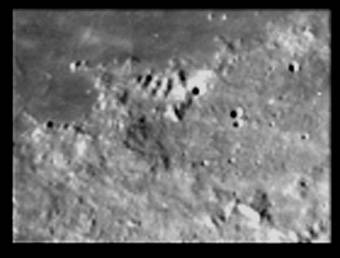
Below is a picture of pyramids on the border of the lunar crater Pythagoras. There is a certain order to their arrangement. There is a similar grouping of pyramids, also exhibiting arrangement, in the crater Aristillus. Also, a lone mount, called Monte Pico, exists in northern Mare Imbrium; Monte Pico is interesting because it is 2,400 meters high, and its base measures 15 X 25 kilometers; also because of its pyramidal shape.
The D & M Pyramid on Mars:
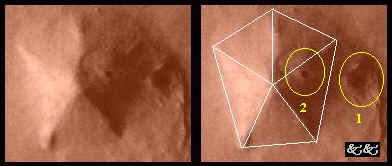
Another Image of the D & M Pyramids
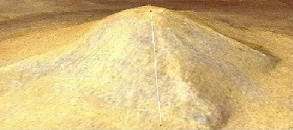
"Richard Buchli D.V.M. Ph.D. writes, "We have just learned that this pyramid that I found on Mars [Immediately above] is the famous D&M pyramid that is a mile and a quarter high. Mr. George J. Haas has dedicated an entire chapter to this pyramid in his new book "Martian Codex". Any of you that are interested in the things we have been finding on mars may be very interested in obtaining a copy of this book."
The pyramidal shape of these structures are not typically brought to your attention in science class in school, nor do you see reports about their shape on TV, nor is their pyramidal shape frequently addressed in astronomical circles, and when it is, it is often minimized or sloughed off.
The pyramids of Egypt and the Sphinx have been closely liked with Vedic culture. Writer P.N. Oaks has linked the name Egypt with Ajapati, descendents of Aja, Shree Rama’s grandfather. Etymologically, P.N. Oaks equates the title of Egypt’s ancient rulers, the dynasty of Ramesis, with the Sanskrit words "Ram Eisus," meaning "Ram The Lord." Mr. Oaks identifies the Sphinx with the word "Sing" in Sanskrit, meaning lion, as this was an ancient word for the sovereign. It is a common linguistic trait of words which have descended from Sanskrit and become corrupted that the letter p is often silent and the letter h hardly pronounced. In English, the word sing corrupted itself into king.
On page 613 of his book Our World Vedic Heritage, Mr. Oaks presents a picture of an ancient, Egyptian statue of a man dressed in robes and practically covered with Vishnu tilak and sandal paste, the kind which the Shree Vaishnava sect uses in South India. The caption identifies the man as a designer of the pyramids and a Dravidian. The picture was originally produced in the book Egyptian Myth and Legend, on page 368, as well as in the book: Long Missing Links. On the next page P.N. Oaks produces another picture from the book Long Missing links, that of a pharaoh of Memphis. The pharaoh is also using tilak just like the Shree Vaishnavas.
Miles and miles of tunnels and chambers exist underneath the pyramids in Egypt, so deep that they still have not been fully explored. Where do they go? In the Egyptian Book of the Dead, there are numerous references to opulent, subterranean worlds, accessed through these tunnels, and the tunnels under Tibet are deemed to lead directly to Shambala/Shangri La, a Vedic city in the hollow earth.
Bhaktivedanta Swami, Prabhupada, stated in the purport to Canto 4, Chapter 22, Text 54, that "The Vedic literature, however, repeatedly informs us that the Moon is full of highly elevated inhabitants who are counted amongst the demigods."
Therefore, could it be that Pyramids on any planet, be it Mars, the Moon or the Earth, indicate underground entrances to the civilizations described in the Puranas? The "elevated inhabitants," of which the Moon is "full of", according to Shrila Prabhupada Bhaktivedanta. Could they live in an underground, lunar world, accessed through openings on the surface which are marked by pyramids? We know that the Puranas tell of Vedic civilization on other planets, so this seems to be a reasonable conclusion.
Another Pyramid?
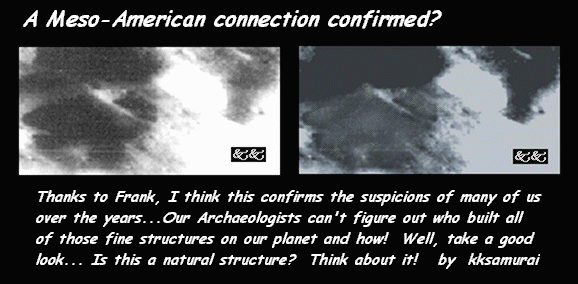
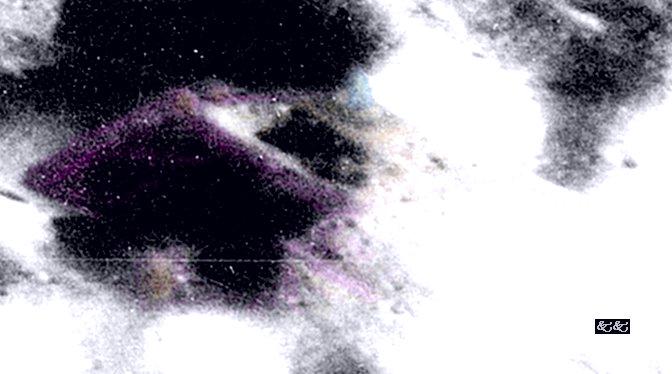
This data is also an enlarged clip from NASA image AS11-38-5564, but it was processed at 1000 dpi. Not only can we see a clearer more defined structure, but we also see a dome complete with a compression ring at it's base, right where it should be!... Evidence of engineering??? Is this a natural formation or is it a structure created by intelligent beings, possibly eons ago?
The two images immediately above were culled from the now defunct kksamurai site.
And one more!
A pyramid at the crater Ryder in the Aitken Basin close by the Lunar South Pole:
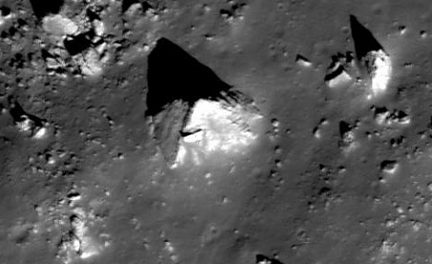
43.677* South, 143.246* East. The Crater Ryder is about 15 kilometers in Diameter.
Source: NASA/GSFC/Arizona State University
Notice the flat sides and angles. It is surely a pyramid, but it has suffered dilapidation or perhaps an attack, in the distant past.
How could anyone build a pyramid on The Moon if The Moon doesn't have enough mass to induce enough gravity effects in order to hold down an atmosphere? Well, if we accept that gravity effects are due to electromagnetic attractions and repulsion, then gravity effects would not depend on mass. In this case, gravity would function similar to magnetism. (It has been argued that the atom has a net positive charge, and of course electromagnetic particles are negatively charged)
Dean's Corner · Contents · Section: Hollow Earth in the Puranas — Vedic Articles and Comments · ← Olaf Jansen on Sanskrit: the Language of the Inner World · Rakshasha Influence: Make the Connection — Western-Oriented Hindus and Vedic Dharma →
Pages of interest
Hollow Earth Puranas · Krishna Comments · Aryan Invasion Revised · Vedic Culture Remains in Hollow Earth · Rakshasha Influence · Sons of Sagara in the Hollow Earth · Hollow Venus · Seven Days North of Tibet · Olaf Comments on Sanskrit · You Could Learn a Lot from a Daitya! · Arctic Home of the Vedas · Abduction of Duryodhana · Nagas · Thunderbirds! · Flying Snakes · Ossendowski on Tibet · Maricha and Other Shapeshifters · Hollow Orbs Home