Originally published on skywebsite.com/hollow/hollowearthscience/id18.html (2002-03-05), a page of Dean De Lucia's website; recovered from the Internet Archive.
The Reasons the Earth's Magnetic Poles are not Located at the Geographic Poles
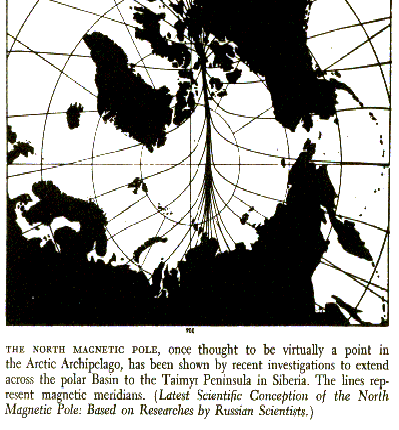
The fact that the Earth's magnetic poles are far removed from the geographic poles. and that they tend to shift, has always been a puzzle to geophysicists and other experts. The concepts revealed in this treatise provide a simple answer to this dilemma. A magnetic pole is defined as the point where the magnetic inclination, or the angle at which the compass needle points downward, is 90 degrees.This is the direction of the magnetic lines of force or the general flow of ether particles. At the north magnetic pole the flow is downward, and is upward at the opposite pole.
In actuality, the so-called poles are not sharply defined. The lines along which the inclination is very close to 90 degrees are quite extensive, and follow a closed path around [ within ] the lip of each of the large egresses into the hollow earth. The flow of ethers which produce the magnetic field will follow the lines of least resistence, as is the case with any fluid. Since these openings produce a void, so to speak, the flow of ethers concentrated in the higher latitudes [ of the inner shell ], will concentrate at these openings. The concentration of soft electrons at any area fluctuates. Consequently, the so-called magnetic pole will also have a tendency to shift.
A high concentration of soft electrons is radiated out of the openings from the interior. This means an inordinate concentration exists around the openings. Since the openings are not located at the geographic poles, they will assume the rotational velocity of the Earth in these areas. Therefore, an additional magnetic field will be produced in these regions and in the same direction as the general flow of ethers. Similar nodal points, or lines, encircle the Earth at the lower latitudes, as mentioned in Chapter 20, because ether flows tend to follow circular paths going in and out of the Earth's shell. Such nodal lines will be much weaker. A similar case exists along a bar magnet of considerable length.
( An Excerpt fromT he Ultimate Reality, by Joseph H. Cater. See link below. )
Circular, Depicted As If Linear
The Archive · skywebsite.com — The Hollow Earth · Dean's Corner