Lunar and Martian Atmospheres, Illuminated
Compiled by Dean Dominic De Lucia, with comments
An Excerpt from UFOs and the Complete Evidence from Space by Daniel Ross-
"A detailed look at some of NASA’s color photographs provides evidence of the Moon’s atmosphere. In their official publication, “Apollo 8 - Man Around the Moon “ are three color photographs which confirm the presense of a dense atmosphere. Along the entire visible rim of the Moon, as seen and photographed from space by the Apollo 8 astronauts, there is a substantial brightness of the limb- and effect that can only be attributed to a gaseous layer around the Moon. Mars, Venus, and the Earth all present this same limb brightening due to their atmospheres.
On page 12 of the Apollo 8 booklet is a space photograph of Earth, showing the Earth's own limb brightness. On page 14 of the same booklet is a full picture of the Moon, taken by the astronauts from interplanetary space, and it shows an identical limb brightening along the rim. Firsoff points out
that both of the space photographs of the Earth and the Moon were taken on the same film with the same camera, and since we accept that there is an atmospheric blanket around our planet, it would be quite illogical to deny the same such reality behind the same limb brightening in the case of the
Moon.
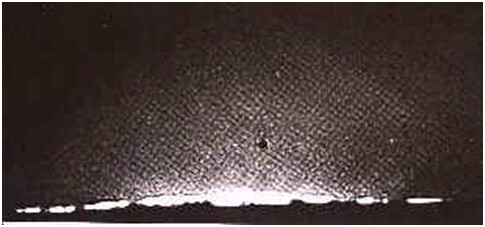
The lunar probes Ranger, Lunar Orbiter and Surveyor and the Apollo missions photographed the faint haze of light spreading out over the lunar horizon just prior to sunrise, and the soft illumination of lunar twilight after the Sun dipped below the Moon's limb. These effects require an atmosphere. Oblique pictures, such as Plate 17, clearly show soft gray shadows made by an evening sun on the lunar far side. Yet astronomers believing in an airless Moon have always insisted that all lunar shadows are pitch black.
...
Both Jessup's The Expanding Case for the UFO and Firsoff’s Strange World of the Moon are difficult to find. The latter is even difficult to read, unless you have an exceptional interest in geology, astronomy, and technical science. But a study of these two books would readily prove, that years later, NASA cleverly concealed the truth about the Moon's environment. In the final analysis, NASA only proved one thing for mankind - that it was technologically possible for a spaceship to get to the Moon and back. A technological success for man, but a formidable cover-up for mankind.
Formidable means difficult to surmount. Today it is unlikely that even one person in a thousand believes that there could be life on the Moon. Yet it is there. It has always been there. The government knew it back in the 1950's, with the secret observatory studies. Also, there is an atmosphere which moderates the climate and temperature in certain regions, and one of sufficient density to support vegetation. It is time to re-examine the early evidence of selenography.
The Moon has its own unique time cycle. In 29.5 of our days, it has essentially gone through a full season. Any longitudinal area will have had about 14 continuous days of sunlight (timed by our clocks) as the sun rises and sets, followed by another 14 days of night darkness. Since the Moon's axis is nearly perpendicular to the plane of the ecliptic, there are no different seasons, (no winter or summer), only a monthly cycle.
The late Harvard professor W. H. Pickering photographed the effects of an atmosphere during lunar occultations of Jupiter and Saturn. An occultation refers to the temporary disappearance of a celestial body as it passes behind a closer planet or moon. Separately, when the planets were at the line of contact with the limb of the Moon and partly covered, Pickering's negatives showed a clear, unmistakable dark band crossing the disks of Jupiter and Saturn that measured 3 seconds of arc wide. In other words, the Moon's atmosphere extends 3 miles above its surface with sufficient density to provide a photographic effect. This observation was also made by the expert selenographers, Barnard and Douglas.
...
Astronomers have always insisted that the question of lunar atmosphere can be answered by the way in which stars are "occulted" by the Moon. Since stars passing behind the rim of the Moon appear to snap out instantaneously, astronomers readily conclude that there must not be an atmosphere there. If there was a gaseous layer, they say that the effect should be as obvious as the case of a star occultation by Venus, where the extensive atmosphere makes the star appear to flicker and fade briefly before disappearing behind the rim of the planet. But Venus' atmosphere is much denser, and the planet's size too massive, to compare the effects.
William Brian, a recent Moon researcher, suggests that a lunar atmosphere would be very clean, due to the lack of high winds and other weather conditions. Since the lunar atmosphere would not generally be carrying dust and water vapor by surface winds, he points out that light diffusion and scattering effects would be minimal. Therefore, the occultation of stars would not be as pronounced, even if the Moon possessed a dense atmosphere.
Firsoff writes in his book that he observed the occultation of two stars in March 1957 while using a 6.5-inch reflector. Neither star 'snapped out' at contact with the rim of the Moon, but dimmed rapidly, then flickered brilliantly, before dimming again and finally disappearing. At the time of observation the Moon was a narrow crescent 2.5 days after the New Moon, and Firsoff stated that the effect could not be seen at a fuller phase, probably due to the background glare of the moonlit sky. Since we are dealing with different conditions for the Moon, the observational results do not come as easily as observing the Venusian atmosphere effects. This instance seemed to be an excellent combination of timing, seeing conditions, and most importantly - professional objectivity.
Indeed, Firsoff wrote that the observation was a clear and unmistakable confirmation of a lunar atmosphere - that there is a gaseous layer, low over the surface of the Moon. To this statement can be added the evidence provided from a study by the American Association of Lunar and Planetary Observers. This group of independent astronomers catalogued dozens of observations of faint meteors flashing near the Moon's surface. An atmosphere around the Moon provided sufficient friction for these meteors to become incandescent to earthbound observers.
Firsoff also recorded that he observed an auroral streamer near the southern pole of the Moon in May 1955. His telescopic view showed a dancing and sparkling glow, from which a faint beam of light suddenly detached and shot up vertically into the lunar sky. As it ascended the beam became more intense, while fading out at the base, and finally disappearing. The length of the beam was estimated to be nearly 100 miles, and the auroral display reminded him of the colorful northern lights he had seen in Scotland, an effect that certainly requires an atmosphere.
The lunar atmosphere could be tenuous and still account for these various observations mentioned, as Firsoff pointed out. He took a cautious approach at the time, which was probably reasonable, due to the accepted gravitational theories of the day. However, other discoveries suggested that basic assumptions about the Moon could be fundamentally wrong, and that the strange lunar world might have many surprises in store for us.
On July 22, 1954, Firsoff telescopically viewed the sunset on the Moon's Apennines, a prominent mountain range bordering the Mare Imbrium. Using different filters for comparison, he proved to himself that sunset on the Moon was really red, an effect that other astronomers had also observed. This was amazing to Firsoff, (he even called it thrilling), for the reddening clearly indicated the presence of a gaseous layer over the Moon containing water and carbon dioxide molecules.
For the Sun's light to become reddened, it has to pass through a layer of gas of sufficient density. Noting that this is quite conspicuous at sunrise and sunset on Earth, Firsoff explained that the Moon's atmosphere shows the same positive reaction to sunlight at the end of its day. This meant that the lunar air was dense enough to hold water and C02 molecules.
Immediately following sunset, is twilight. There is a small time interval before dark which we call twilight, when our atmosphere is illuminated by the sun which has dropped below the horizon. Without an atmosphere, there would be no period of twilight. As soon as the sun dipped below the horizon, it would be totally dark (nighttime)."
The following three images were culled from Fred Steckling's book, We Found Alien Bases on the Moon.
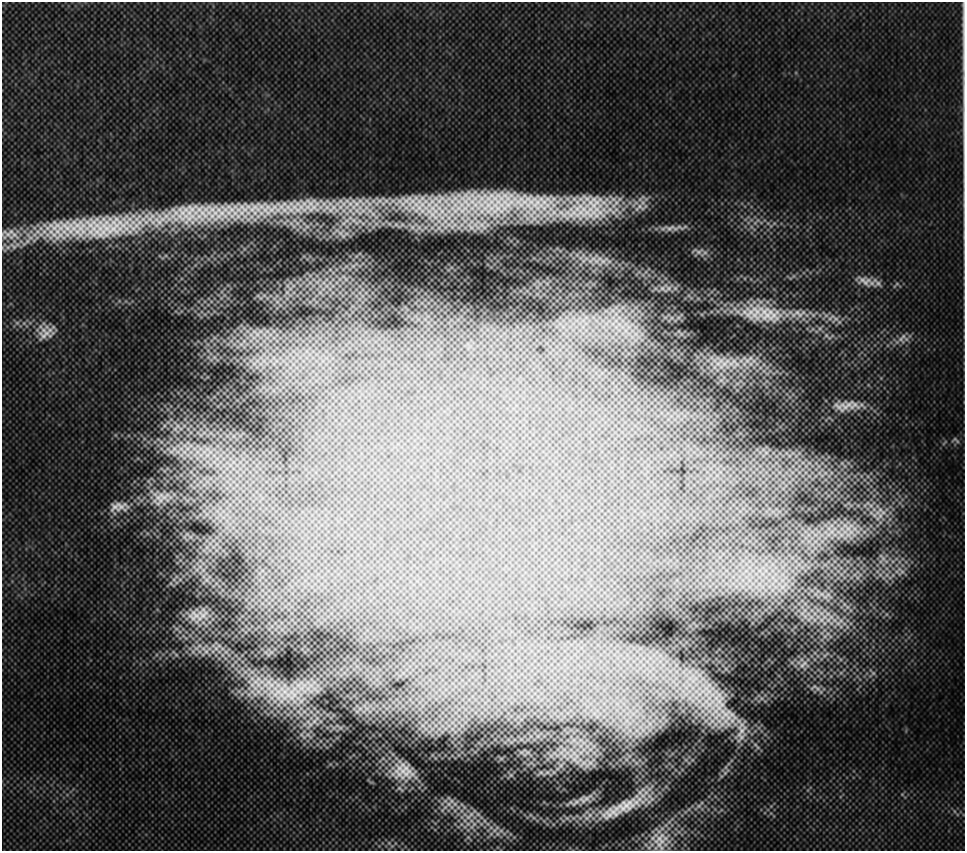
He identifies the first two, below, as Apollo 14 images, numbers 14-10279 and 14-10280. He rightly interprets the picture as depicting a cloud or mist which moved out of the crater. Note that the mist stayed together without dispersing, and moved across the lunar surface.
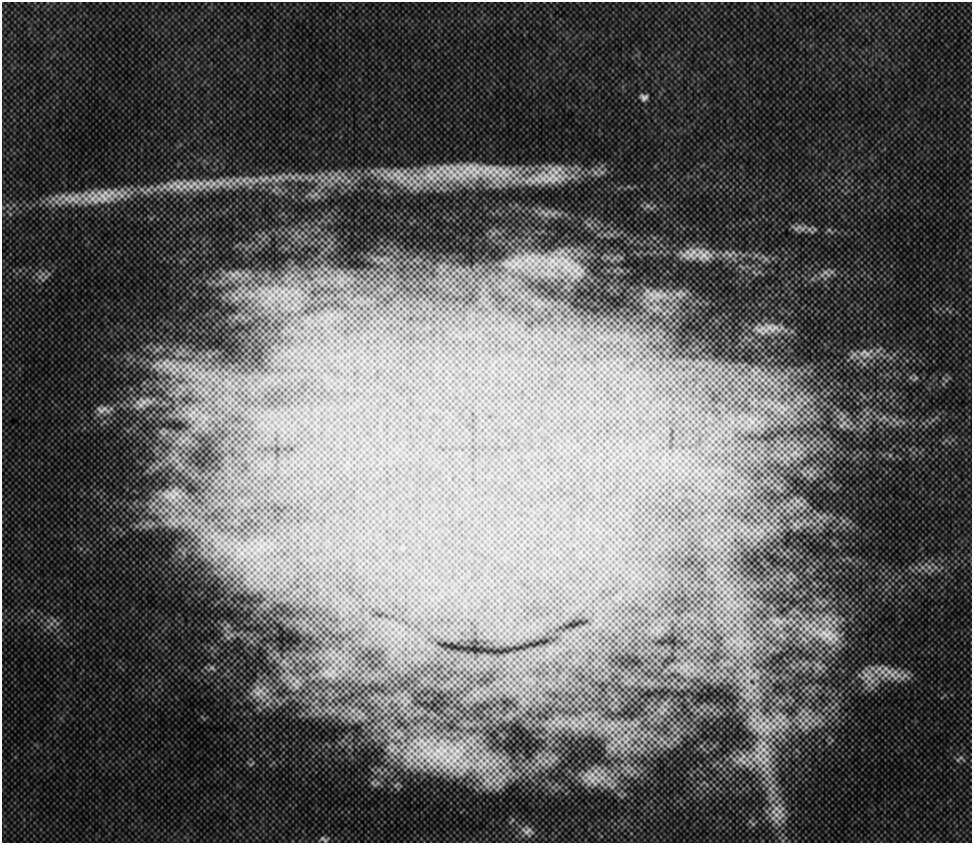
And …
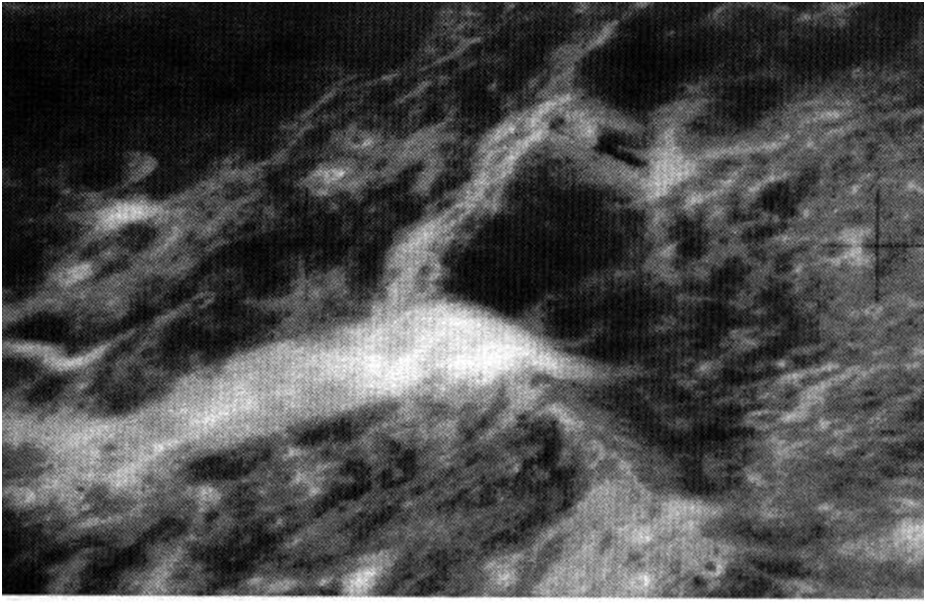
Finally, image number 16-758 below, from Apollo 16, shows a long cloud fingering its way through a mountainous, crater rim, through some pass or low point. (Below)
“Also notice the large oval abject on the crater edge casting a shadow” Fred Steckling.
[End of Daniel Ross quotes]
On Page 14 of his book The Awesome Life Force, Joseph H. Cater elucidates: “Other powerful evidence of a dense moon atmosphere came from statements made by astronauts during Apollo missions. The following case is a typical example. Prior to the publicized excursions to The Moon, early astronauts had stated that the stars were not visible above the atmosphere. This is to be expected. There is little or no diffusion of light in outer space and therefore, the only stars that could be seen would be those whose disks could be resolved. This could only be done with powerful telescopes. An atmosphere functions in a manner analogous to a lens. The light from a distant star is diffused and spread out. Consequently, stars are only visible because of a greatly enlarged and distorted image of the disc caused by the atmosphere.
On the Apollo 11 mission shortly before reaching The Moon, Armstrong stated that he could see the crater Tycho clearly and that he could see the sky all around The Moon, even on the rim of it where there is no earthshine or sunshine. Collins then stated, "Now we’re able to see stars again and recognize constellations for the first time on the trip . . .. The sky's full of stars ... it looks like its night side on Earth" . This means that after leaving the Earth the astronauts could not see any stars in interplanetary space until they got close enough to the Moon to view them through the upper strata of the Moon's atmosphere! [Emphasis mine]
An extensive moon atmosphere means The Moon has high gravity. Since The Moon is a relatively small planet, a gravity as weak as that attributed to it would be unable to hold an atmosphere of any significance. It is not difficult to see why the evidence of a substantial moon has been cheerfully ignored by scientists past and present. A strong moon gravity, of course, is not compatible with orthodox physics.
Gravity effects are produced by a highly penetrating radiation in the electromagnetic spectrum. The frequency range is located between the lower portion of the infrared and the radar band. The frequency is approximately a trillion cycles per second and more precisely corresponding to wave lengths between .3 and 4.3 mm. The author transmitted this information to various scientific groups in 1958.”
[End of this Cater quote]
Daniel Ross on the Viking 1 Lander, from: UFOs and the Complete Evidence from Space
"The Viking 1 lander was released from the main orbiter, and went down to a landing on the Chryse Plain [Mars] on July 20, 1976. A parachute was used to brake the 1,200 pound lander as it plunged to the surface. We can understand a parachute working in the Earth's atmosphere of several hundred millibars pressure. But since NASA stated that the surface pressure on Mars is only 7 millibars, and less than a millibar a few miles up, what inflated the parachute and caused any kind of drag to slow down the descending lander? The answer is simple: the same dense atmosphere that was photographed during the telescopic studies, and the same one that the NASA censors deny is there.
We were given indirect evidence of a notable atmosphere, with the first color photograph that was transmitted back from the surface on July 21, 1976. Not many people know that it showed a beautiful blue sky. The San Diego Union newspaper printed the photograph in full color on the front page of the July 22 edition, with an accompanying article titled "Planet Boasts Blue Sky." The picture was more than aesthetic. It looked just like the sky on Earth, and strongly hinted that the Martian atmospheric constituency diffuses and breeds sunlight the same as our earthly sky.
According to NASA, recent calculations have shown that the Martian atmosphere has only about 1% of the density of the Earth's atmosphere. This contradicts other findings concerning cloud formations. Dense and very extensive clouds are often detected on Mars. Pictures of the volcano Olympus Mons have shown clouds hovering close to the summit of the mountain, which is supposed to rise 14 miles (22.5 km) above the surrounding countryside. It is claimed that coulds are often found at an elevation of 90,000 feet! This is much higher than any water vapor and ice clouds found on Earth. The fact that they move shows that the air is sufficiently dense at such altitudes to produce winds capable of moving clouds. This indicates that Mars truly has an atmosphere denser than that of the Earth at such elevations."
Pages 232 - 233
[End of second Daniel Ross quote]
Readers – According to newtonian theory, the strength of gravity depends on the density of matter, and thus The Moon would not have enough mass in order to exert enough inertia, pull of gravity, to hold down an atmosphere. But theory cannot negate factual observation. And the fact is that observation does negate the concepts of newtonian gravity, plain and simple. Theory has to fall in line with observation, but observation does not have to obey theory. Otherwise, the tail wags the dog.
The conceptual scheme that gravity effects are due to electromagnetic repulsions and attractions does allow for a smaller orb to exert sufficient gravitational pull. The basic idea is that the nucleus of an atom has a net positive charge, and a cloud of negatively charged electrons orbits the nucleus. If more mass in the form of electrons are added to the atom, its ability to attract positively charged particles increases. If the atom is stripped of electrons in the electron cloud to the point that the positively charged nucleus has a stronger charge than the electron cloud, then the atom’s ability to attract negatively charged particles increases. In this case, less mass has more attraction. The mere quantity and density of mass do not produce gravity effects, it is the total net charge of a particle that produces gravity effects.
Furthermore, the atom – such as the ones that compose our bodies and most all matter – has a net positive charge. The electrons that are emitted by all planets are negatively charged. In this way, our bodies are held to the surface of our planet in a way extremely similar to the way a magnet to a large chunk of iron. Yes, gravity effeccts are due to electromagnetic attractions and repulsions.
On Page 142 – 143 of his book The Awesome Life Force, Joseph H. Cater further elucidates: “Stripping electrons from an atom will give it a strong positive charge. This means it will have greater inertia than before, although less mass. Adding electrons will also increase its inertial properties, if the total resultant charge is greater than the original positive charge. Otherwise, adding electrons will reduce the inertial, properties, and, in this case, increasing the total mass would reduce its inertia.
After the author [Cater speaking] came to this conclusion, he was later gratified to learn that a former Nobel Prize winner, Gabriel Lippman, confirmed this principle in the late nineteenth century. Lippman found that bodies in the charged state offered a greater resistance to acceleration than in the uncharged state. He called it ‘the inertia of static electricity.’ It is not surprising that this monumental discovery was ignored, since it threatened to topple cherished physical concepts. Ironically, Lippmann later received the Nobel Prize for some other comparatively insignificant discovery.”
[End of Cater quote]
This conclusion about the role of electromagnetic attractions and repulsions is crucial in order to understand how it is that The Moon, whatever its true size may be, can generate strong enough gravitational pull in order to hold down an atmosphere.
On the back cover of his book, Daniel Ross states: “There is no mystery about the final truth about UFOs once their origin is learnt and understood. Their origin is the other planets of our solar system, and the space travelers are human in every respect.” [We now know not all of them are]
And this, dear readers, goes a long way towards confirming the Vedic version of human civilization on the planets – and in the planets – of our solar system, what to speak of those in the higher planetary systems. The Vedic descriptions have a scientific basis!
We could go on and on, but for the moment, we have seen that The Moon has an atmosphere. It is a very dry atmosphere and thus a very clear atmosphere, but it is an impressive atmosphere, nonetheless. Theory has to conform to observation, and we have presented alternative theory, too.