July 6, 2001
In Bucolic Normandy, the Earth Is Plunging
By EDMUND L. ANDREWS
EUVILLE-SUR-AUTHOU, France, June 29 — Sébastien Elerbach was finishing dinner at his sister's renovated Norman farmhouse when a thunderous crash erupted in the backyard. Dashing out the door to investigate, he plunged into oblivion.
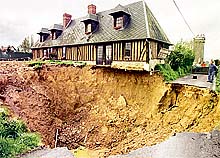
Mr. Elerbach, who was 24, was buried alive in a 40-foot-deep hole that had not been there a few seconds earlier. One corner of the house was suddenly hanging over a vortex of collapsing earth that became deeper and wider by the minute. Despite frantic excavation for weeks after the collapse on March 31, his body was never recovered.
Like a curse in some summer horror novel, hundreds of craters and fissures have been cracking open all over the bucolic expanses of eastern Normandy — in farm fields, in gardens, in the middle of roads and sometimes right under houses.
The reason is what French call "marnières" — abandoned and forgotten underground chalk quarries that have been lying dormant deep below farm land for more than a century. Their entrances plowed over decades ago, their locations rarely documented on any maps, the old caverns and tunnels had receded from almost everybody's awareness.
Agence France-Presse
Heavy rains have caused hundreds of craters and fissures to crack open all over eastern Normandy. One man died when he walked out the backdoor of his sister's farmhouse and fell into oblivion.
Until this spring. Because of some of the heaviest rainfall in decades, water began melting the aging chalk pillars and ceilings as if they were soap in a bathtub.
In March and April, about 20 craters were opening every day. Government officials were forced to condemn 20 houses and order their residents to evacuate. One person drove his car into a crater that had just opened up in the middle of road. And one person, Mr. Elerbach, was killed.
The implosions have abated as drier weather has returned, but problems are just beginning. Government officials estimate that Normandy is riddled with about 140,000 forgotten caverns and tunnels. Many are as small as closets, but others are labyrinths, and a few have chambers as big as ballrooms. And all of them are crumbling.
"All of the marnières will collapse at some point, if they are not maintained," said Patrick Lebret, who is in charge of the Normandy region for the national Bureau of Research for Mines and Geology. "It is a question of age, and the rains have accelerated the process."
Unfortunately, with the entrances covered up, nobody knows exactly where most of the old quarries lie. Government records provide little help, because only a tiny fraction of the quarries were ever registered on maps.
Partly to evade taxes, most farmers never disclosed their digging to the local building or mining authorities. And many of the quarries were dug long before 1850, when the government first began ordering farmers to register their sites.
What people do know is that most of the marnières are between 100 and 400 years old, dug by farmers who excavated chalk and limestone. The farmers used it to reduce the acidity of Normandy's topsoil. The chalk typically lay 10 to 50 yards below the surface, so farmers usually dug narrow vertical shafts and then carved out caverns and corridors.
Most of that ended decades ago. Normandy's character began to change as well, as new housing developments popped up and as the region became a vacation retreat for growing numbers of Parisians. Though local people knew about the marnières, neither construction companies nor government officials made any attempt to locate them and prohibit building over them.
"Naturally, we prohibit anyone from building on top of a marnière," said Florence Declerc, mayor of Neuville-sur-Authou. But, she added, the town learned about the existence of its first marnière only this year, and that was the one that killed Mr. Elerbach.
The first signs of trouble surfaced about six years ago, when a handful of holes opened up in residential areas. In 1997, an entire house disappeared into the ground. But it was only this spring when huge cavities started opening up by the hundreds.
"It is a veritable plague," said Didier Philippe, director of the land and environment division of the government's public works agency. "It is a problem that has been growing, and I expect it will continue to increase."
So far this year, the government has condemned 20 houses and ordered the residents to evacuate. In general, insurance companies are refusing to pay because standard policies cover only "natural catastrophes," and the problems here are considered man-made.
Michel Vanneste and Brigitte Bouillard, who bought a house in the town of Moyoux 20 years ago, were among the victims. Two months ago, the couple were awakened in the middle of the night by loud cracking sounds followed by what sounded like the boom from a cannon.
No hole appeared in the house or the yard, but huge cracks began running through the kitchen and then spreading through the house. The local authorities concluded that the foundations were crumbling over a marnière and declared the house too dangerous to live in.
"The house is dead," Miss Bouillard said. Since April, she and Mr. Vanneste, a house painter, have been living above the local schoolhouse in a small apartment that has been provided at no cost by the city. But the apartment is too tiny for their furniture or even their appliances, so Miss Bouillard goes to the old house everyday to do her washing.
"It would be less expensive for us to buy a new piece of land and build a new house than it would be to have this piece of land filled in and the house repaired," Miss Bouillard said. "We lost our health in this affair, and we are wondering what is going to happen to us."
City officials are ordering them to pay for a full geologic investigation, which would cost about 57,000 francs, or $7,600. Actually repairing or filling the old cavities could easily cost more than $100,000, according to S O S Marnière, an association of victims.
Jasmond Beurferey, who lives with her husband, Jean, on a tiny farm plot near the town of Bernay, now lives with a 30-foot crater about 20 yards behind the house.
"For two days, it was like thunder rumbling in our backyard," Mrs. Beurferey said. "It started about two and a half months ago, and it just grew and grew and grew." Today, the area and the road adjacent to the pit have been sealed off with barbed wire by the authorities.
André Lecoq, a retired factory worker, is trying to figure out if he has a problem or not. Two months ago, a five-foot crater opened up in his neighbor's front yard. The crater is less than 10 feet from the wall of his own house, but the city has no record of any quarry at all, and it is anybody's guess whether the cavern extends beneath his house.
But even those who are lucky enough to find quarry maps for their property have a big challenge. André Denouette, a retired firefighter in the town of Bourgtheroulde and a co- founder of S O S Marnière, was surprised by a small crater in his backyard several years ago.
In his case, city archives showed that there was a maze of corridors that cut diagonally across his backyard and right next to his 200-year- old farmhouse. Mr. Denouette would like to fill up the old quarry with concrete, but he cannot come close to raising enough money. He would consider moving, but nobody will buy his house, and he cannot afford to pay rent as well as the remainder of his mortgage.
Political leaders from this region are pushing proposals in Parliament that would compensate homeowners if their property is condemned as a result of a marnière.
Even homeowners who have big reasons to worry are doing little to have their land investigated.
"It would cost huge amounts of money, and it would not be conclusive," said André Jejeux, who moved into a sumptuous home here less than a year ago. Next door, a couple of hundred yards away, is the pit that still holds the remains of Mr. Elerbach.
Leslee wrote:
http://www.nytimes.com/2001/07/06/world/06FRAN.html?todaysheadlines