From Mysteries of Ancient South America, Page 48, by Harold T. Wilkins:
"Another of these old Atlantean cities was visited by Fray Pedro Ciezade Leon, a Spanish soldier-monk, who died in A.D. 1560. It was called Guamanaga, and is and was located on the great cordillera in latitide 12* 59' S, longitude 73* 59' W. Ciez was tremendously impressed by the great edifices he saw there, all in ruins.
"Who built them?" he asked the natives.
A bearded White people, like you Spaniards," said a cacique.
"They came to these parts many ages before the Incas began to reign and formed a settlement here ... They do not seem to me to be Inca buildings; for they are square, not long and narrow. It is also reported that certain letters were found on a tile in these buildings ... the indians also speak of bearded white men in the island. of Titicaca."(Cieza de Leon)
Does anyone want to get on Google Earth and look up this coordinate?
From Mysteries of Ancient South America, Page 48, by Harold T. Wilkins:
"Another of these old Atlantean cities was visited by Fray Pedro Ciezade Leon, a Spanish soldier-monk, who died in A.D. 1560. It was called Guamanaga, and is and was located on the great cordillera in latitide 12* 59' S, longitude 73* 59' W. Ciez was tremendously impressed by the great edifices he saw there, all in ruins.........................
Does anyone want to get on Google Earth and look up this coordinate?
I don’t
know how long you have been on the list, or to what degree you have familiarity
with the concept of underground worlds. Keep in mind, though, that some of them
have been described as being huge, even containing underground seas; and some
as having, shall we say, space restrictions.
My idea is
that the cities or settlements (Machu Pichu) above them serve to guard the
entrances and receive resources from above ground. The Aztecs had organized
very large-scale production in their region, and the Amazon warriors along the
river directly controlled vassal-indian villages that worked large plantations
that stretched for many days journey by pack animal.Tribute was paid to the
Amazons, and it seems that the production was more than the population could utilize
all by themselves.
Was the
purpose of the Amazon control above-ground to supply the worlds below with food
and resources? Could this explain the existence of Indian towns in
out-of-the-way places?
I noticed that the city was along a river. It looked to me like it may have been at the headwaters but I'm not much of an analyst of satellite photos. ;->
I don’t know how long you have been on the list, or to what degree you have familiarity with the concept of underground worlds. Keep in mind, though, that some of them have been described as being huge, even containing underground seas; and some as having, shall we say, space restrictions.
My idea is that the cities or settlements (Machu Pichu) above them serve to guard the entrances and receive resources from above ground. The Aztecs had organized very large-scale production in their region, and the Amazon warriors along the river directly controlled vassal-indian villages that worked large plantations that stretched for many days journey by pack animal.Tribute was paid to the Amazons, and it seems that the production was more than the population could utilize all by themselves.
Was the purpose of the Amazon control above-ground to supply the worlds below with food and resources? Could this explain the existence of Indian towns in out-of-the-way places?
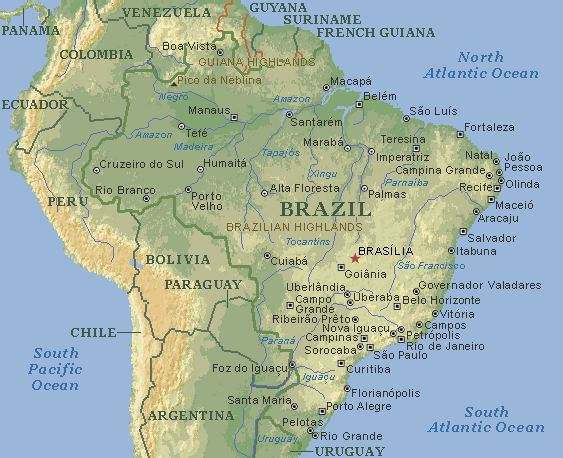
One of the Amazon warrior's stomping grounds were the headwaters of then Orinoco. The Harold T Wilkins books identify various ancient constructions in Southern Venezuela.
His books are filling in a lot of blanks for me.
Have you sem some of my Brazilian/Venezuelan pages?
Amazon_wolfpitte
The tunnel systems that span the length and breadth of the Andes Mountains are fairly well known about, as we venture into the 21st Century.