BBC News | SCI/TECH | Jupiter's 'northern lights'
low graphics version | feedback | help
You are in: Sci/Tech
Front Page
World
UK
UK Politics
Business
Sci/Tech
Health
Education
Entertainment
Talking Point
In Depth
AudioVideo
Thursday, 12 April, 2001, 18:03 GMT 19:03 UK
Jupiter's 'northern lights'
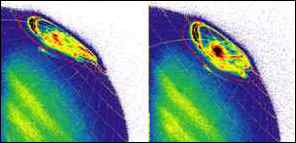
The light show grew to the size of the Earth in 70 seconds
By BBC News Online science editor Dr David Whitehouse
Astronomers have witnessed the first auroral flare ever seen on Jupiter.
The dramatic flare occurred while they were watching Jupiter's north pole through the Hubble Space Telescope.
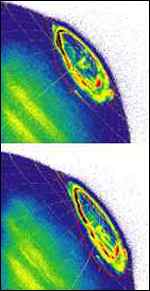
They were observing the so-called auroral oval, a permanent glowing ring that encircles each of the planet's poles.
It faded as quickly as it grew
They saw an expanding region of light that covered an area the size of Earth in a matter of minutes, and disappeared just as fast.
No explanation
Earth's northern lights or aurorae occur when electrons in the solar wind penetrate our planet's magnetosphere. They interact with the upper atmosphere causing it to glow.
Scientists believe that the eerie glow near Jupiter's poles is also caused by interactions between electrons and the planet's atmosphere, but the electrons come from Jupiter and not the solar wind.
Some believe that the electrons originally come from volcanoes on Jupiter's moon Io.
Charged particles given off by them spiral towards Jupiter and are energised by Jupiter's magnetosphere, releasing light at the auroral oval.
Somehow a burst of these electrons were channelled onto one particular region near Jupiter's north pole causing the dramatic rise in emissions.
However, the researchers, describing their observations in the journal Nature, do not yet have an explanation for the precise mechanism that caused the dramatic flare.
Search BBC News Online
Advanced search options
BBC RADIO NEWS
BBC ONE TV NEWS
WORLD NEWS SUMMARY
BBC NEWS 24 BULLETIN
PROGRAMMES GUIDE
See also:
06 Apr 00 | Sci/Tech
Planets put on a show
25 Apr 00 | Sci/Tech
Close-up on Jupiter's moons
19 May 00 | Sci/Tech
Io's wandering volcanoes
17 Dec 00 | Sci/Tech
Jupiter moon may have ocean
Internet links:
Hubble Space Telescope
Nature
The BBC is not responsible for the content of external internet sites
Top Sci/Tech stories now:
Galactic 'cannibalism' in action
Flying bugs get the chop
Iceland to resume whaling
UK web stats 'notoriously inaccurate'
Patient gets first mechanical heart
'Coolest ever' computer put on ice
Giant world detected in deep space
Gene bank to save rare breeds
Links to more Sci/Tech stories are at the foot of the page.
Links to more Sci/Tech stories
In This Section Galactic 'cannibalism' in action Flying bugs get the chop Iceland to resume whaling UK web stats 'notoriously inaccurate' Patient gets first mechanical heart 'Coolest ever' computer put on ice Giant world detected in deep space Gene bank to save rare breeds CJD diagnostic test 'ready in a year' Awards for British innovators Elephant-sized fertility treatment Japan worried on climate treaty Another leap in evolution debate Farming 'facing massive job losses' Q&A: Are pesticides getting into food? First stellar 'heartbeat' heard Eggs 'created' for older women Government lifeline for lab test firm Quest for Universe's oldest light Europe discusses wind power Cyberwar the coming threat Hundreds flock to science centre Virus hoax aims to dupe MP3 users A 'gift of galaxies' Scientists find firefly 'switch' Chaos clues to dino demise Will prints continue to finger criminals? Private rocket launch is 'suicidal' Silicon chips go flat out Zebra hybrid is cute surprise
--------------------------------------------------------------------------
^^ Back to top
News Front Page | World | UK | UK Politics | Business | Sci/Tech | Health | Education | Entertainment | Talking Point | In Depth | AudioVideo
----------------------------------------------------------------------------------
To BBC Sport>> | To BBC Weather>>
----------------------------------------------------------------------------------
News Sources
Related thread: Jupiter's Particles Escape Route Found — Jupiter aurora coverage following this topic