2001 News Releases
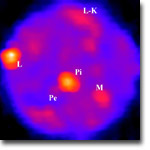
Temperature Map of Volcanic Moon Io Presents a Puzzle
June 22, 2001
Earth's tropics are hotter than the polar regions for a good reason, so scientists are puzzled that the same pattern doesn't show on Jupiter's moon Io.
A new map of Io's nighttime surface temperatures comes from NASA's Galileo spacecraft. Aside from hot spots at volcanic sites, night temperatures on Io appear to be about the same near the equator as near the poles even though, as on Earth, the equator gets more direct sunshine to heat the surface.
The Io temperature map is available online at Io | NASA Jet Propulsion Laboratory (JPL) , and a new, enhanced-color Galileo image of Europa's icy surface is available at http://www.jpl.nasa.gov/images/europa. The Europa image proved useful in a study of the age of that moon's surface by Dr. Cynthia Phillips of the SETI Institute, Mountain View, Calif. Captions are posted with the images.
Some 250 scientists meet June 24-30 in Boulder, Colo., to discuss Io, Europa and other members of the Jupiter system. Dr. John Spencer, of the Lowell Observatory, Flagstaff, Ariz., will describe some possible explanations for Io’s odd heat balance. For example, the poles may have more volcanic heating than the lower latitudes, or they may be surfaced with materials that cool off slower at night.
The Jet Propulsion Laboratory, a division of the California Institute of Technology in Pasadena, manages Galileo for NASA's Office of Space Science, Washington, D.C. For more about Galileo, visit http://galileo.jpl.nasa.gov. Information about the Jupiter conference is at http://lasp.colorado.edu/jupiter. Lowell Observatory's home page is at http://www.lowell.edu.
A greater concentration of soft particles in the atmosphere would
spread out the temperature differential. This is because the soft
particles have a tendency to absorb the hard ones, the ones which
give off heat, the ones perceptible to touch.
Mr. Cater feels that the Moon has such an atmosphere and that the
surface doesn´t heat up as much as one might think for this reason-
even during the long lunar day, soft particles absorb the heat and
average out the temperatures.
DD
NASA's Galileo spacecraft. Aside from hot spots at volcanic sites,
night temperatures on Io appear to be about the same near the equator
as near the poles even though, as on Earth, the equator gets more
direct sunshine to heat the surface.
Dick, the process does start when soft particles reach the
atmosphere. In fact, there is some attenuation as the particles pass
through the cosmic rays of space. But the lion´s share of
disintegration does not ocurr until the particles begin to pass
through the crust. Remember the Man in Etidorhpa? He reported faint
luminescense at a point which the Guide told him was 12 miles below
the level of the sea. And it was quite a bit below that that he
started seeing light proper.
they do. Hard particles are mixed in the sunlight, certainly by the
time they arrive to the actual sirface. Soft particles, photons and
hard particles are all mixed in, and ether is omnipresent, regardless
of the Sun. Cater accomodates all this.
I'm Speculating (because of Churchward's atmospheric
experiments) that Cater may be quite innocently "lumping together"
all rays (admittedly invisible to HIS and our perception) under his
catch-all label of "soft particles."
No, but remember- hard particles of sunlight only penetrate about two
meters. The lion´s share of penetration is carried out by soft
particles. Even the hard particles break up and form lower frequency,
soft particles, especially given the fact that there is an
omnipresent ether flow, even through the shell, and that soft
particles have broken up, too, leaving constituent photons lying
around which can combine with the hard particles which break up.
Again, the penetration which ultimately let´s loose warmth and light
is carried out by soft particles, even though hard particles and
photons are present in the sun´s rays on the surface.
About soft particles or Photons from the Sun (you've
interspersed the two in several of your recent emails), isn't it
also
Cater's belief that WITHIN our atmosphere they cause both Light and
Heat?
Only photons, not soft particles. Soft particles are formed of
photons, but they are not visible to our eyes. Maybe this is how
creatures of the night, such as cats, see in the dark. Their retinas
perceive the soft particle flow. They can see in caves, right?
Remember, soft particles are like houses, and photons are like
bricks. Once the photons combine into aggragate particles, they don´t
function the same anymore.
If so, isn't sufficient FRICTION involving atmospheric
elements happening, to then "release," "separate" or "disintegrate"
soft and hard particles WITHIN the atmosphere which then produces
Heat and Light?
It begins in the atmosphere, which is why it is warmer at lower
elevations, but most of the soft particles are still robust enough to
penetrate 12 miles of crust and only begin to disintegrate, so a lot
of integral soft particles, still containing heat in the form of hard
particles, were able to escape Mr. Churchward´s attention.
Surely Cater (like Churchward) has carried out personal,
practical laboratory experiments, to prove his beliefs about hard
particles (within) soft particles producing heat and light in our
atmosphere. Are such examples in his book?
He mentions a few, such as the experiment with 38 huge, metali
morrors. And we´ve already seen the examples of Wilhelm Reich and
Baron Von Reichenbach. There are a few more and some examples from
life and nature.
Maybe just as important, in his book, Mr. Cater shares the deductive
logic which brings him to his conclusions. He just didn´t think up
the nature of soft particles and ether, and the way that they
combine. For example, other particles behave in a similar fashion,
such as super fine gases. It is a matter of applying the same
behavior to higher frequency, subtler particles, and of assuming that
light is forming aggragate particles which we then, apparently ,
don´t see. All the other photons form particles of hard matter, so
why wouldn´t photons in the visible range be doing the same thing? (
soft particles ) The logic is strong. If we can´t perceive the
product, that doesn´t take away from the logic, nor from the fact.
There is a method to Cater´s madness, and your mind would be able to
drink it all up, I´m sure.
Dean... Just a quick reply. Thanks for your detailed answers. But now I've got to read through them again a few dozen times! My comprehension went "south" a bit, trying to "picture" what you just explained in several in several of your answers. Having another cup of coffee first.