Originally published on skywebsite.com/hollow/realmoonhollowmoon/id16.html (2002-04-20), a page of Dean De Lucia's website; recovered from the Internet Archive.
Atmospheric Glare on the Sunrise Horizon
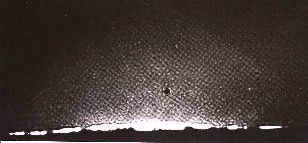
The above is an Apollo photograph of Sinus Medii.
" A detailed look at some of NASA's color photographs provides evidence of the Moon's atmosphere. In their official publication, ' Apollo 8- Man Around the Moon ' there are three color photographs which confirm the presense of a dense atmosphere. Along the entire visible rim of the Moon, as seen and photographed from space by the Apollo 8 astronauts, there is a substantial brightness of the limb- and effect that can only be attributed to a gaseous layer around the Moon. Mars, Venus, and the Earth all present this same limb brightening due to their atmospheres.
On page 12 of the Apollo 8 booklet is a space photograph of Earth, showing the Earth's own limb brightness. On page 14 of the same booklet is a full picture of the Moon, taken by the astronauts from interplanetary space, and it shows an identical limb brightening along the rim. Firsoff points out that both of the space photographs of the Earth and the Moon were taken on the same film with the same camera, and since we accept that there is an atmospheric blanket around our planet, it would be quite illogical to deny the same such reality behind the same limb brightening in the case of the Moon.
Both the Orbiter probes and Apollo missions photographed the faint haze of light spreading out over the lunar horizon just prior to sunrise, and the soft illumination of lunar twilight after the Sun dipped below the Moon's limb. These effects require an atmosphere. Oblique pictures, such as Plate 17, clearly show soft gray shadows made by an evening sun on the lunar far side. Yet astronomers believing in an airless Moon have always insisted that all lunar shadows are pitch black."
Daniel Ross, UFOs and the Complete Evidence from Space. ( See link below )
Additional comments by Daniel Ross:
" Astronomers have always that the question of lunar atmosphere can
be answered by the way in which stars are " occulted " by the moon.
since stars passing behind the rim of the moon appear to snap out
instantaneously, astronomers readily conclude that there must not be
an atmosphere there. If there were a gaseous layer, they say the
effect should be as obvious as the case of a star occultation of
Venus, where the extensive atmosphere makes the star appear to
flicker and fade briefly before disappearingbehind the rim of the
planet. ButVenus' atmosphere is much denser, and the planet's size
too massive, to compare effects.
William Brian, a recent moon researcher, suggests that alunar
atmosphere would be very clean due to the lack of high winds and
other weather conditions. Since the Lunar atmosphere would not
generally be carrying dust and water vapor by surface winds, he
points out that light diffusion and scattering effects would be
minimal. Therefore, the occultation of stars would not be as
pronounced, even if the moon possessed a dense atmosphere."
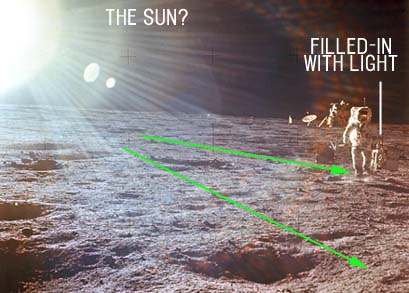
Side-scatter Glare on the Moon, indicating atmosphere? Or a studio picture?
Comments by Cater:
Evidence shows that the Moon does not experience the extremes of temperature one would expect from the long days and nights. This can be readily accounted for because of two factors, the extremely high concentration of soft electrons in the atmosphere and their degree of stability. The particles that accumulate in the atmosphere are the more stable ones. This means fewer disintegrations which release hard electrons and also a tendency to absorb excess hard electrons that are released. This blanket along with the dense atmosphere, tends to minimize the escape of heat from the surface during the long nights. A similar process prevents temperature extremes on Mars. Mars undoubtedly has a relatively thin shell like the Moon since it does not seem to have large openings into the hollow interior. The resulting negative ion content would prevent gravity from compressing the atmosphere to the extent the Earth does its atmosphere. Consequently, air density would not drop off with increases in elevation as rapidly it does on the Earth. As a result, ideal temperatures and atmospheric densities would exist at extreme elevations, as is shown on Olympus Mons at about 75,000 feet. Similar conditions would exist on the Moon.
( From The Ultimate Reality, Chapter 15 )
The Archive · skywebsite.com — The Hollow Earth · Dean's Corner